What is Last-Mile Industrial?
Last-mile industrial is local fulfillment and delivery space near customers. How it overlaps small bay flex parks, grade-level doors, and dock-high needs.
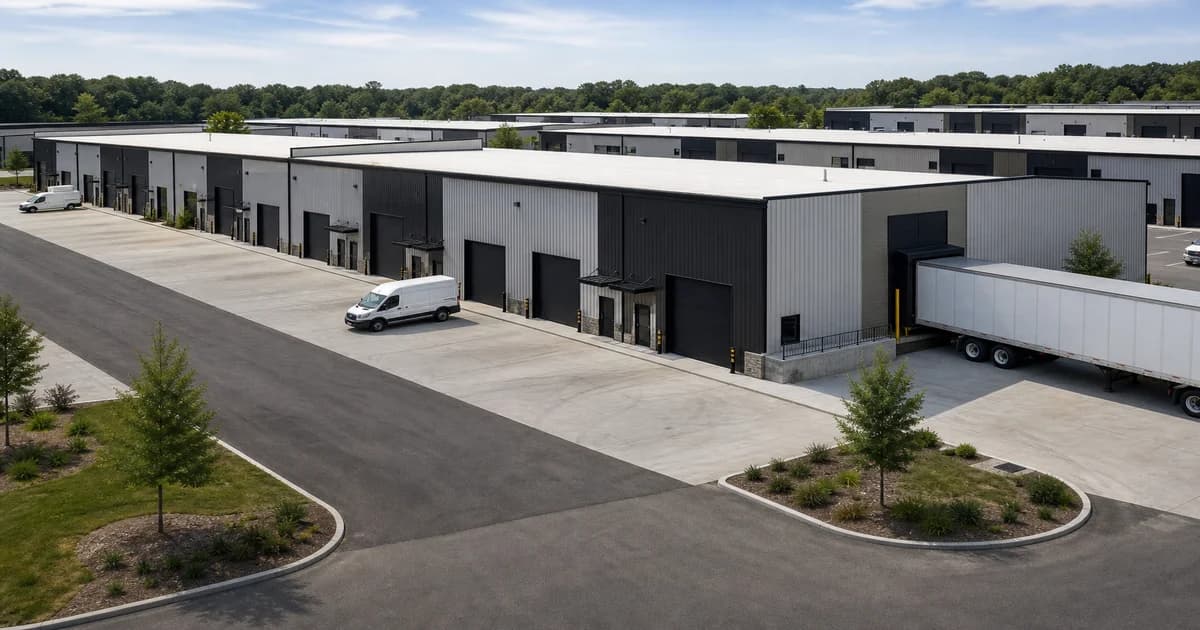
TL;DR: Last-mile industrial is space used for the final leg of delivery or local fulfillment, positioned near population centers. Dedicated last-mile buildings can be larger single-user hubs. Small bay and flex parks capture related demand from couriers, e-commerce operators, and service fleets that need vans, grade-level doors, and proximity, not 53-foot trailer courts.
What "last mile" means
In logistics, the last mile is the final handoff from a local facility to the end customer. Same-day and next-day expectations pull inventory and drivers closer to rooftops.
In real estate, "last-mile industrial" usually means:
- Infill or close-in industrial / flex locations
- Fast vehicle turn for vans and box trucks
- Enough clear floor for sort, stage, and short-term storage
- Access that works for residential-adjacent routes
It is a use case and location pattern more than a single building prototype.
Where small bay fits (and where it does not)
Dedicated last-mile product often runs larger than a classic contractor bay: think mid-box infill warehouses, sometimes 10,000–50,000+ SF, occasionally with more dock capacity.
Small bay / flex still participates because many last-mile operators are small:
- Independent courier and delivery contractors
- Regional e-commerce sellers doing their own fulfillment
- Service businesses that stage parts and roll vans daily
- Light distributors covering a metro from multiple small depots
Those tenants often lease 2,000–8,000 SF suites in multi-tenant parks. They care about drive time and door access more than institutional cross-dock design.
Specs that matter for last-mile-style users
Spec | Why it shows up |
|---|---|
Location / trade area | Route density beats cheap rent 30 miles out |
Grade-level roll-up doors | Vans and box trucks enter or stage at grade |
Parking and yard space | Overnight vans, trailers, short staging |
| Clear height | Modest racking and mezz staging; not bulk DC heights |
Power | Charging, conveyors, or light sort equipment in some shops |
Zoning / hours | Residential adjacency can limit overnight noise and truck type |
Dock-high doors help when a tenant takes occasional full trailers. Most small bay last-mile users live on grade-level access. Deep truck courts sized for 53-foot trailers are a big-box logistics problem, not the default small bay brief.
Last-mile vs flex vs small bay (labels)
These terms overlap in listings and get used loosely.
- Last-mile describes proximity and delivery / fulfillment function
- Flex / small bay describes the multi-tenant, mixed office-warehouse product many of those operators actually lease
- The same building can be marketed as flex, small bay, and last-mile depending on the broker and the tenant
Treat the label as a search term. Underwrite the unit: doors, yard, parking, clear height, power, and drive times.
Who leases it
From who leases small bay, the last-mile-adjacent slice includes:
- Parcel and courier contractors
- E-commerce and wholesale distributors with local inventory
- Trade contractors whose "last mile" is job-site delivery rather than parcel
- Auto and equipment service users that stage mobile fleets
Not every infill flex park is a last-mile hub. Not every last-mile lease belongs in a 20-unit contractor garage park. Match use to neighbors, parking, and lease rules on outdoor storage.
Underwriting notes
For landlords:
- Demand is location-sensitive; vacancy in close-in product can stay tighter than fringe industrial
- Fleet tenants stress parking, yard rules, and after-hours activity
- CAM and wear on drive aisles rise with high vehicle counts
For tenants:
- Model drive time and parking before rent
- Confirm exclusive vs shared yard and overnight parking rules
- Check whether the lease and insurance allow your vehicle mix and storage
Rent and NNN stack for a suite are the same inputs as in the lease calculator.
The Bottom Line
Last-mile industrial is about putting goods and drivers close to customers. Dedicated hubs can look like mid-box warehouses. A large share of related demand still shows up as ordinary small bay and flex suites: grade-level doors, van parking, and infill locations. Define the use, then pick the building specs. For the broader asset class, start with What is small-bay industrial? and What is flex industrial?.