What is Flex Industrial?
Flex industrial (flex space) combines warehouse, light manufacturing, and office in adaptable layouts. Specs, uses, and how it relates to small bay.
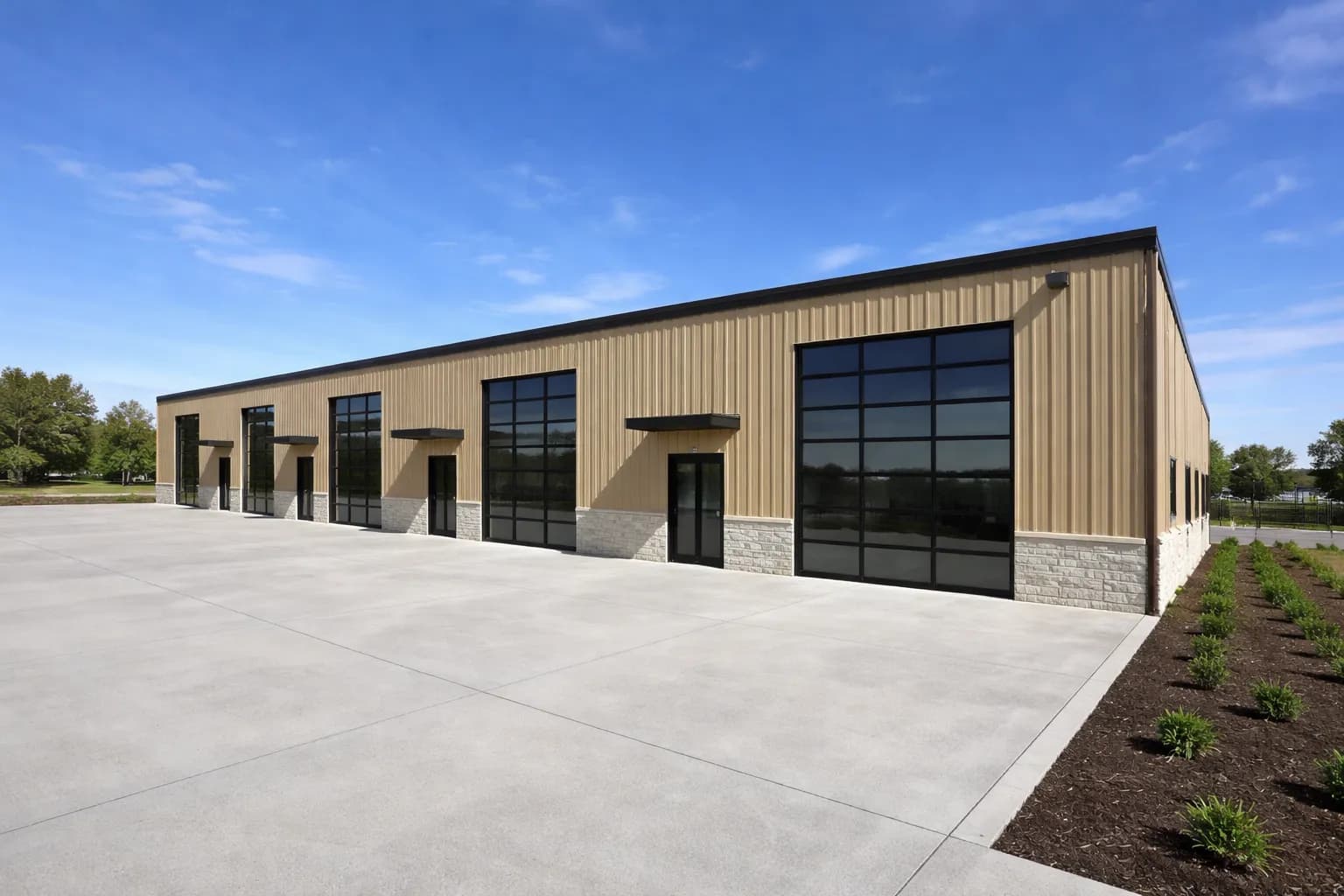
TL;DR: Flex industrial (or "flex space") combines warehouse, light manufacturing, and office functions in a single adaptable building. Units typically feature 70-90% warehouse with 10-30% office, 12-24 ft ceilings, and drive-in doors. Flex is popular with contractors, e-commerce, light manufacturers, and service businesses seeking cost-effective, versatile space.
What is Flex Industrial?
Flex industrial, commonly called "flex space," refers to commercial buildings designed for maximum adaptability. These properties combine warehouse or light manufacturing space with office or showroom areas in configurations that can be easily modified to suit different tenant needs.
The defining characteristic of flex space is its versatility. A single building might house a contractor's office and equipment storage, an e-commerce fulfillment operation, a light manufacturing shop, and a medical equipment distributor, all with different space configurations.
Key Characteristics of Flex Space
Flex industrial properties typically share these features:
- Building height: 1-2 stories, rarely more
- Ceiling clearance: 10 to 24 feet clear height in warehouse areas
- Office ratio: 10-30% office/showroom, 70-90% warehouse (flex space)
- Loading: Drive-in / grade-level doors and/or small dock-high doors
- Site: Higher parking ratio than big-box; sometimes exclusive yard space
- Fire protection: Commonly sprinklered, which caps racking and mezzanine options
- Zoning: Light industrial or mixed-use
- Unit sizes: 500 to 10,000+ SF typical, split by demising walls
What Makes Flex Different from Traditional Industrial?
The key distinction is adaptability:
Feature | Flex Industrial | Traditional Industrial |
|---|---|---|
Office Component | 10–30% | 5–15% |
Ceiling Height | 10–24 ft | 24–40 ft |
Configuration | Modular/adaptable | Fixed purpose |
Loading | Drive-in doors | Dock-high doors |
Parking | Higher ratio | Minimal |
Tenant Type | Diverse | Specialized |
Who Uses Flex Industrial Space?
Flex space attracts businesses that need multiple functions under one roof:
Contractors & Trades
- Office for admin and sales
- Warehouse for equipment and materials
- Shop space for fabrication or assembly
E-Commerce & Distribution
- Fulfillment and packing areas
- Customer service offices
- Returns processing
Light Manufacturing
- Production floor space
- Quality control and testing
- Administrative offices
Professional Services
- Medical equipment suppliers
- IT and technology companies
- Engineering and design firms
Showroom Retail
- Product displays
- Back-of-house inventory
- Customer meeting areas
Benefits of Flex Industrial
For Tenants
- All-in-one space: Office, warehouse, and production in one location
- Lower costs: More affordable than separate office and warehouse leases
- Scalability: Expand or contract within the same building
- Location: Often in urban/suburban infill locations near customers
- Flexibility: Reconfigure space as business needs change
For Investors
- Tenant diversity: Multiple industries and business types
- Stable demand: Essential businesses need operational space
- Rent growth: Limited supply drives pricing power (learn about lease structures)
- Repositioning potential: Convert office-heavy space to meet market demand
- Lower cap-ex: Simpler construction than specialized industrial
Flex Space Configurations
Flex buildings accommodate various layouts:
Front Office / Rear Warehouse
The most common configuration. Professional office space facing the street with warehouse accessed from the rear.
Showroom / Storage
Retail-style showroom in front with inventory storage behind, popular with distributors and wholesalers.
Production / Admin
Manufacturing or assembly floor with adjacent office space for management and admin staff.
Split Use
Building divided into separate office-only and warehouse-only units to serve different tenant needs.
Market Trends Driving Flex Demand
Several trends are increasing demand for flex industrial:
- E-commerce growth: Last-mile fulfillment needs flexible space
- Reshoring: Domestic manufacturing requires adaptable facilities
- Hybrid work: Companies consolidating office + warehouse operations
- Supply chain resilience: Businesses maintaining local inventory
- Service economy: Trade contractors and service businesses expanding
Flex vs. Small-Bay: What's the Difference?
These terms are often used interchangeably, but there's a distinction:
- Flex describes the building type: adaptable warehouse/office hybrid
- Small-bay describes the tenancy: multiple small tenants in one building
In practice, most small-bay industrial properties are flex buildings, and most flex buildings are leased as small-bay multi-tenant properties. The terms overlap significantly, which is why the asset class has so many different names.
The Bottom Line
Flex industrial is an adaptable warehouse-office hybrid. Businesses use it when they need operational space and a modest office or showroom in one unit. Investors underwrite it as multi-tenant income with local demand, not as a single-tenant big-box substitute.
Rent math for a typical suite is in the lease calculator. For the category definition that overlaps this format, see What is small-bay industrial?.