What is Cap Rate (and How Do You Calculate It)?
Cap rate is NOI divided by property value. Going-in vs exit caps, what moves small bay industrial yields, and how to calculate the number.
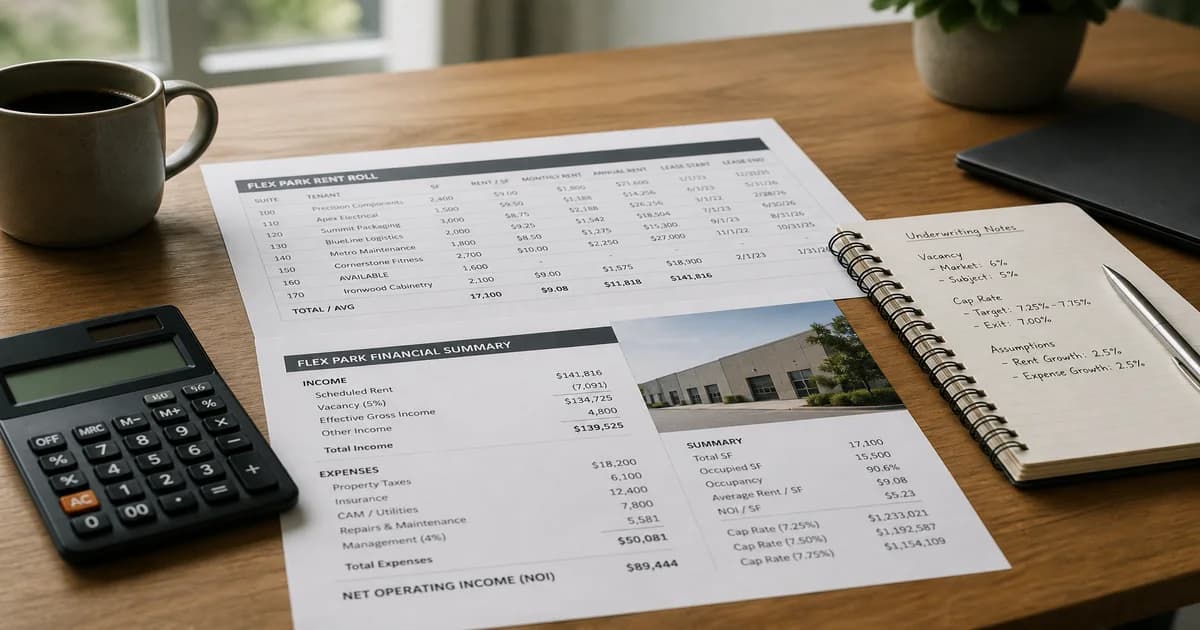
TL;DR: Cap rate is NOI divided by the property's price or value. It shows the income return before any loan payments. Buyers often look at a going-in cap rate at purchase and an exit cap rate when they model a future sale. On small bay industrial, how you build NOI (vacancy, expenses, recoveries) usually changes the result as much as the cap rate itself.
What is a cap rate?
Cap rate is short for capitalization rate. It compares a property's yearly net operating income to its price.
In plain terms:
- Start with NOI for the year you care about
- Divide by the purchase price (or the value you are testing)
- Write the result as a percent
If NOI is $70,000 and the price is $1,000,000, the cap rate is 7%. That means the building's operating income is 7% of the price, before mortgage payments.
Cap rate does not include financing. Two buyers can pay the same price for the same NOI and end up with different cash-on-cash returns once debt is in the model.
The formula
Cap Rate = NOI / Property Value
You can flip it to price a deal:
Value = NOI / Cap Rate
The cap rate calculator and NOI calculator use that same relationship. A clean cap rate still needs a clean NOI.
Worked example
Say a multi-tenant flex park shows:
- Trailing twelve-month NOI: $292,800
- Purchase price: $4,200,000
Cap rate = $292,800 / $4,200,000 = 7.0%
If a buyer wants a 7.5% going-in yield on that same NOI:
Max price = $292,800 / 0.075 = $3,904,000
These numbers are for illustration only. Cap rates on small bay industrial vary widely by market, vintage, tenant mix, lease structure, and how NOI is defined. A band that fits one metro or building age can miss another entirely. Local sales comps matter more than any national average.
Going-in vs exit cap rate
People use "cap rate" for a few related ideas. The table below separates the common ones.
Term | What goes into it | What it is used for |
|---|---|---|
| Going-in cap rate | First-year or in-place NOI ÷ purchase price | Entry yield on the purchase |
| Exit cap rate | Assumed sale yield on NOI in the exit year | Estimate a future sale price in a model |
Market / trailing cap | Reported NOI ÷ a recent sale price (or asking price) | See what traded or is listed today |
Going-in asks what yield you are buying today. Exit asks what yield you assume the next buyer will want when you sell.
Many models set the exit cap at or a bit above the going-in cap so the sale price does not rely on the market getting more expensive for the same income. A small cushion (often about 0.25% to 0.75%) is a common conservative choice. If a model exits at a lower cap than entry, the assumptions behind that should be clear (for example, lease-up finished or major repairs done).
Cap rate follows NOI
The percent is only as useful as the income number behind it. On small bay deals, these NOI choices often move the implied cap rate:
- Vacancy and unpaid rent across many short-term tenants
- In-place rents that sit below (or above) current market, and how long empty units take to fill
- Which operating expenses the landlord still pays after recoveries
- Whether a market-rate management fee is included when an owner self-manages
- Whether big repairs are treated as operating expense or capital
NNN and modified gross leases also change whose expenses sit in landlord NOI. Comparing a gross-lease NOI to an NNN NOI without adjusting for that difference can misstate both value and yield. For the income side, see What is NOI? and Gross, Modified Gross, or NNN.
What can move small bay cap rates
Lower caps (higher price for the same NOI) often show up with:
- Strong locations and limited competing supply
- Stable occupancy and a spread-out tenant mix
- Newer buildings with less deferred maintenance
- Stronger tenants or longer remaining lease terms when those are present
Higher caps often show up with:
- Lease-up risk or a lot of near-term renewals
- Deferred roof, pavement, or HVAC work
- One large tenant, or very few tenants carrying most of the rent
- Weaker locations or buildings that are harder to lease (low clear height, poor truck access, awkward unit mix)
Small bay can price differently from big-box logistics in the same metro. More units, more turnover, and more day-to-day management are part of what buyers are pricing.
Cap rate vs other return metrics
Metric | Simple formula | What it tells you |
|---|---|---|
Cap rate | NOI ÷ price | Income return before debt |
| Cash-on-cash | (NOI − debt service) ÷ cash invested | Cash return after the loan |
| Yield on cost | Stabilized NOI ÷ total project cost | Return on a build or value-add plan |
| DSCR | NOI ÷ annual debt service | How well income covers the loan |
A deal can look fine on going-in cap rate and weaker on cash-on-cash if the loan is expensive. The opposite can happen too. The cash-on-cash calculator and yield on cost calculator sit next to the cap rate tools for that reason.
Common mistakes
- Using face rent with no vacancy or unpaid rent, then calling it a market cap rate
- Mixing a seller's adjusted NOI with the buyer's all-in price without saying so
- Comparing NNN and gross buildings on raw NOI without aligning expense responsibility
- Using exit cap only as a knob to hit a target IRR
- Mixing up cap rate with cash-on-cash or IRR
- Treating an asking cap on list price as if the property already sold at that number
The Bottom Line
Cap rate is NOI divided by price. Going-in describes the yield at purchase. Exit is an assumption used to price a future sale. The percent only helps if the NOI behind it is defined the same way a buyer would underwrite it.
Try the cap rate calculator with a clear NOI stack, then check cash-on-cash if the deal is financed. For the income side of the fraction, start with What is NOI?. Related terms: going-in cap rate, exit cap rate, yield on cost.