What is a Triple Net (NNN) Lease?
A triple net (NNN) lease passes taxes, insurance, and CAM to the tenant on top of base rent. How NNN works in small bay industrial, vs modified gross.
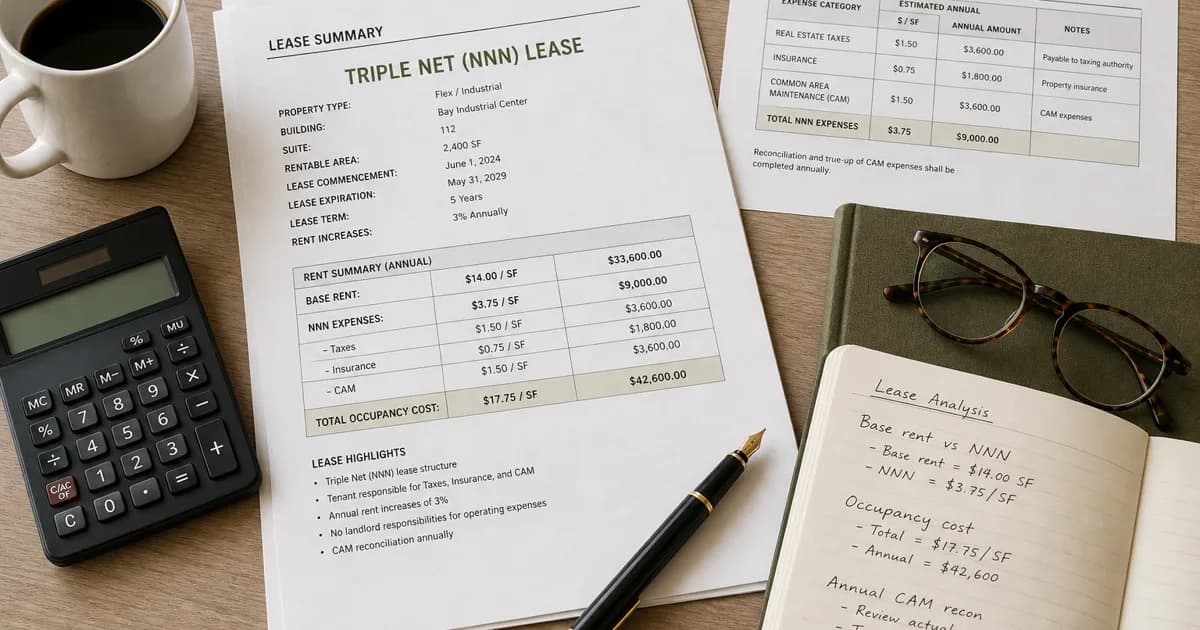
TL;DR: A triple net (NNN) lease means the tenant pays base rent plus their share of property taxes, building insurance, and CAM / maintenance. Landlords get more predictable NOI. Tenants take more expense risk and need a clear all-in occupancy cost. NNN is usually less simple for tenants than a modified gross or gross lease, which is one reason those structures also show up often in small bay industrial. The mix varies by market.
What "triple net" means
The three "nets" are the major operating expense buckets passed through to the tenant:
- Real property taxes
- Building / property insurance
- Common area maintenance (and related recoverable operating costs)
Base rent is the contractual rent for the space. NNN charges sit on top of it. Utilities inside the suite are usually separate and tenant-paid either way.
Compared with modified gross or gross leases, NNN asks the tenant to track estimates, year-end true-ups, and expense risk. That is less tenant-friendly and less obvious on a listing that only quotes base rent, so many parks still use modified gross or gross, especially where tenants expect a simpler all-in number. NNN remains common where landlords want expenses passed through clearly.
NNN is a cost-allocation structure, not a promise that the landlord has zero obligations. Leases still define structural repairs, roof, exterior, and what is recoverable versus landlord-retained.
How NNN billing usually works in small bay
Most multi-tenant parks do not wait until year-end to collect expenses.
Typical flow:
- Landlord budgets annual recoverable OpEx
- Each tenant pays monthly estimates based on pro-rata share (tenant SF ÷ building SF)
- After year-end, actual expenses are compared to estimates
- Tenant receives a bill or credit in CAM reconciliation
Pro-rata share is the allocation math. CAM language is the rulebook for what counts as recoverable.
Base rent vs occupancy cost
Listings quote base rent. Tenants live with occupancy cost.
Occupancy cost ≈ Base rent + NNN expenses + suite utilities
Illustrative year-one stack for a 2,500 SF suite:
- Base rent: $14.00/SF
- Estimated NNN (taxes, insurance, CAM): $3.50/SF
- Face occupancy cost before suite utilities: $17.50/SF
- Annual base rent: $35,000
- Annual estimated NNN: $8,750
Figures are typical-band examples. Actual NNN loads vary by market, tax jurisdiction, insurance, and how aggressively the park is managed. Monthly rent and expense math can be checked in the lease calculator; if you have tenant revenue, occupancy cost puts the same stack in context.
NNN vs modified gross vs gross
Structure | Tenant pays | Landlord expense risk |
|---|---|---|
| Gross | Base rent only (usually) | High |
| Modified gross | Base rent + some expenses (often above a base year) | Medium |
NNN | Base rent + taxes, insurance, CAM | Lower on recoverable OpEx |
For a side-by-side decision framework, see Gross, Modified Gross, or NNN. This page stays on definition and mechanics.
Absolute NNN / bondable variants push even more responsibility to the tenant (sometimes including roof and structure). Those appear more often in single-tenant credit deals than in multi-tenant small bay parks.
Why landlords use NNN
- Expense inflation largely passes through instead of eroding NOI
- Cap-rate and debt underwriting can treat income as closer to collected rent minus residual landlord costs
- Multi-tenant parks can allocate shared costs with a consistent formula
NNN does not eliminate landlord work. Estimating, billing, reconciling, and defending CAM still create admin load, especially with 20–100+ tenants.
What tenants should underwrite
- All-in $/SF, not just base rent
- What the lease includes in CAM and what it excludes
- Controllable vs uncontrollable expenses, and any caps if present
- Timing of estimates vs reconciliation (cash-flow spikes at true-up)
- Vacant-suite and landlord-retained costs that never hit the tenant bill but still affect the landlord's NOI story
Contractors and local operators often accept NNN because it is market-standard. Problems show up when a "cheap" base rent hides a heavy expense load, or when reconciliation arrives with weak backup.
Small bay specifics
- Many short leases (often 1–3 years) mean frequent onboarding mid-year and prorated reconciliations
- Pro-rata share changes when demising walls move or units combine
- Owner-operators sometimes under-recover management costs; buyers may impute market fees when reading NOI
- Rent escalations apply to base rent unless the lease says otherwise. NNN expenses move with actual costs, not with the escalation schedule
Worked example (illustrative)
Building: 50,000 SF multi-tenant flex
Tenant: 2,500 SF (5% pro-rata share)
Budgeted recoverable OpEx: $175,000 / year ($3.50/SF)
Monthly estimated NNN charge:
$175,000 × 5% / 12 = $729
If actual year-end OpEx is $190,000, the tenant's annual share is $9,500 instead of $8,750. The reconciliation bill is the difference after monthly estimates already paid (same true-up logic as in CAM reconciliation, and the calculator if you want to step through it).
The Bottom Line
A triple net lease splits the deal into base rent for the space and a pass-through stack for taxes, insurance, and CAM. Compare leases on occupancy cost and lease language, not headline rent. For structure choice across gross / modified gross / NNN, see the comparison guide. For income after expenses, see What is NOI?.