Flex Industrial vs Self Storage: Side-by-Side Guide
Flex industrial vs self storage for small bay developers: use cases, unit size, lease terms, operations, site selection, and underwriting inputs.
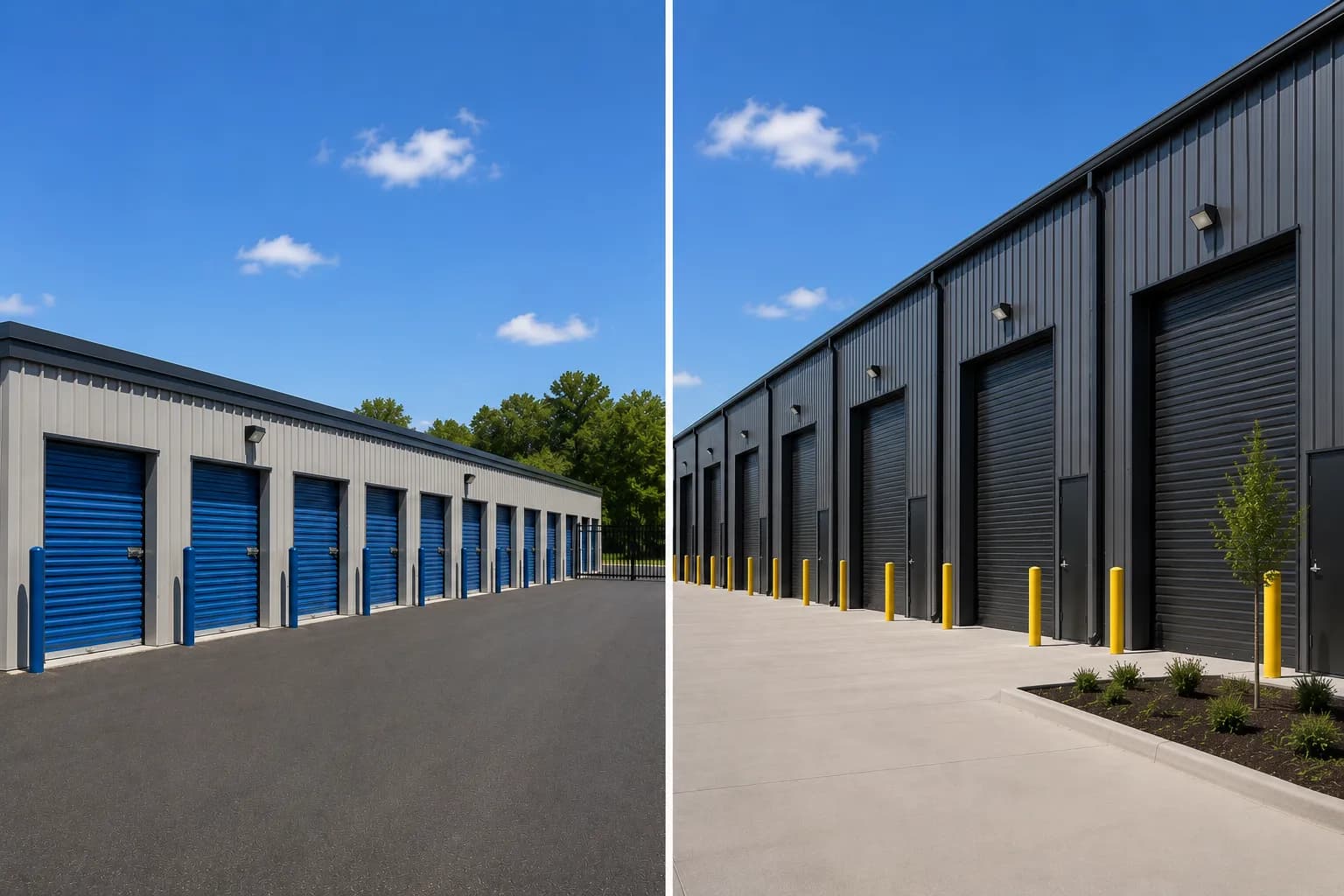
TL;DR: Flex industrial and self storage share single-story, light-industrial construction roots but serve different users. Flex leases operating space to businesses on multi-year terms that may be NNN, modified gross, or gross depending on the market. Self storage rents small units to consumers and businesses, usually month to month. The figures below are typical industry bands that vary by market, vintage, and lease structure. Neither is categorically better. Which one pencils depends on your site, capital, buyer pool, and appetite for operations.
How the Two Compare at a Glance
Self storage rents enclosed units, commonly 50 to 300 SF, for holding goods. Tenants are consumers and small businesses on month-to-month agreements, and the operator manages rate, marketing, and turnover like a hospitality asset.
Small-bay flex leases functional business space, commonly 1,000 to 10,000 SF, where a tenant runs an operation: a contractor's shop and yard, an e-commerce packing line, a distributor's inventory and counter. Leases run multiple years, and the space carries the power, doors, and clear height that businesses need to work.
Both often sit on light-industrial land and use similar single-story shells, so developers frequently evaluate the same parcel for either use. The flex side is what the industry calls flex space: a warehouse-and-office hybrid a tenant occupies to run a business. The differences show up in tenant behavior, lease structure, operating intensity, and how the asset trades on exit.
By the Numbers
Treat every range below as a rough illustrative band, not a rule. Rents, occupancy, and especially cap rates move a lot with submarket, product vintage, tenant mix, and lease terms. A band that fits one metro or building age can miss another entirely. Storage figures in particular have also shifted with the 2019–2024 supply cycle.
Metric (typical ranges) | Self Storage | Small-Bay Flex |
|---|---|---|
Unit size | 50–300 SF | 1,000–10,000 SF |
Building size | 20,000–120,000+ SF | 20,000–150,000 SF |
Rent PSF (annual) | $15–25 effective | $12–25 (NNN / MG / gross) |
Lease term | Month-to-month | 2–5 years |
Stabilized occupancy | 85–92% | 92–97% |
Lease-up period | 24–48 months | 12–24 months |
Annual turnover | 50–60% | 15–25% |
Avg tenant duration | 12–18 months | 3–5 years |
Construction cost PSF | $45–150+ | $65–150+ |
Operating expense load | Higher (staff, marketing) | Lower to moderate (varies by lease) |
Stabilized cap rate (wide band) | ~4.5–9.0%+ | ~5.0–9.0%+ |
Use Cases and Tenants
Self storage serves demand tied to transitions and overflow: moving, downsizing, estate changes, seasonal inventory, and small-business records or stock that does not need to be worked on site. Decisions are price-sensitive and convenience-driven, and a tenant will move for a modest monthly saving.
Flex serves businesses that need to operate, not just store. Trade contractors, distributors, service firms, and light manufacturers use the space daily for people, vehicles, tools, and inventory. See what defines flex industrial for the warehouse-plus-office profile these tenants rent. Relocation is disruptive and expensive for them, which tends to lengthen tenure and reduce price sensitivity relative to storage.
The practical read: storage demand is broad and consumer-weighted, flex demand is narrower and business-weighted. Storage refills faster from a larger pool. Flex fills slower but holds longer.
Unit Size and Building Format
Storage units are small and numerous, and unit mix (small vs. large, climate vs. non-climate) drives revenue per SF. Multi-story climate-controlled product concentrates rentable area on premium land, while single-story drive-up product spreads across cheaper sites.
Flex bays are larger and fewer, typically demising a shell into 1,000 to 10,000 SF units with grade-level roll-up doors, 14 to 24 ft clear height, dedicated power per bay, and a modest office build-out. Fewer, larger units mean fewer leases to manage but more concentrated vacancy exposure when a bay rolls.
Drive-Up Storage vs. Small-Bay Flex
The comparison tightens for single-story drive-up storage, which competes with flex for the same light-industrial land. The buildings look similar from the street, but permitted use and specs differ.
Factor | Drive-Up Storage | Small-Bay Flex |
|---|---|---|
Unit size | 100–400 SF | 1,000–5,000 SF |
Ceiling height | 8–10 ft | 14–24 ft clear |
Electrical | Lighting only | 200A+ per bay |
Plumbing | None | Restroom per unit or shared |
Office component | None | 10–30% of unit |
Permitted use | Storage only | Business operations |
Drive-up storage costs less to build but caps out at storage-only rents and use. Flex costs more to deliver per SF because of power, doors, clear height, and office finish, and in return it can house tenants who need to run a business on site. A contractor who needs 2,000 SF for trucks, tooling, and a small office cannot operate out of a storage unit regardless of price. That functional line, not a quality judgment, is what usually decides which product a given tenant can even use.
Lease Term and Turnover
Storage runs month to month. That gives the operator frequent chances to reprice, and it exposes the rent roll to constant churn. Turnover of 50% or more a year is normal, so marketing and rate management are continuous costs rather than occasional events.
Flex runs multi-year. Lease structure is market-dependent: NNN, modified gross, or gross all show up in small-bay and flex, and who pays taxes, insurance, and maintenance shifts with that choice. Repricing happens at renewal or through contractual escalations, not daily. Turnover is lower, commonly 15 to 25% a year, but each vacancy is larger and can take longer to backfill. A flex rent roll and its escalations are the same inputs as in the lease calculator.
Operating Model
Storage is management-intensive. Expect revenue-management software, ongoing digital marketing spend, and staff or remote management handling move-ins, delinquencies, and auctions. Revenue per available SF is the operating metric, and margins depend on running the asset actively.
Flex is comparatively lighter to operate once leased, though expense load depends on lease structure. NNN recovers most operating costs from tenants; modified gross and gross leave more with the landlord. Staffing is lighter than storage either way, and marketing is largely broker-driven at lease-up and renewal. Effective rent and retention are the metrics that matter. The tradeoff is concentration: fewer, larger tenants mean a single move-out is a bigger event than in storage.
Site Selection
Storage favors visibility and rooftops. Operators target high-traffic arterials near dense residential population, and many jurisdictions have tightened storage-specific zoning after the recent building wave, which can lengthen entitlement.
Flex favors function over frontage. Truck circulation, yard, utility capacity, and light-industrial zoning matter more than drive-by exposure, and suitable parcels are often cheaper than retail-adjacent land. Both uses compete for the same single-story light-industrial sites in many submarkets, so entitlement risk and land basis are worth comparing parcel by parcel rather than assuming one use always wins the land.
Underwriting Inputs
The two assets underwrite on the same skeleton but with different assumptions:
- Rent and growth: storage reprices frequently off shorter demand cycles; flex locks base rent with contractual escalations over the term.
- Vacancy and credit loss: storage assumes high churn against a broad tenant pool; flex assumes lower churn but larger, lumpier vacancy events.
- Expenses: storage carries payroll, marketing, and rate-management costs the owner absorbs; flex expense recovery depends on whether the market norms are NNN, modified gross, or gross.
- Lease-up: model the lease-up curve and carry reserves separately, since storage stabilization often runs longer than flex.
- Return metrics: run both to a going-in cap rate and to levered cash-on-cash return so operating-cost and financing differences show up, not just headline yield (same comparison as in cash-on-cash).
Storage always carries operating costs on the owner's P&L. Flex may push most of them to tenants (NNN) or leave more with the landlord (modified gross / gross), so match your expense assumptions to the local lease norms before comparing. Headline cap rate alone understates that gap. Compare on levered cash flow after reserves.
Exit and Liquidity
Storage has a deep, mature buyer pool, including public REITs, private equity, and 1031 capital, plus standardized underwriting and available debt for stabilized assets. That supports pricing certainty and liquidity.
Flex has a shallower but growing institutional bid and less standardized underwriting, which can mean wider pricing and a smaller buyer set on exit, alongside the possibility of cap-rate movement as more capital enters the niche. Liquidity favors storage today; that can change by market and cycle.
The Bottom Line
Flex industrial and self storage are different tools, not competitors for the same trophy. Storage offers a broad tenant pool, frequent repricing, deep liquidity, and standardized underwriting, in exchange for active operations, higher expense load, and constant churn. Flex offers longer tenure and lighter day-to-day operations, with expense recovery that depends on local lease structure (NNN, modified gross, or gross), in exchange for slower lease-up, lumpier vacancy, and a thinner exit market.
The right choice is site- and capital-specific. Compare the land basis and entitlement path for your parcel, the operating burden you are willing to carry, and the exit liquidity you need, then underwrite both to levered cash-on-cash rather than headline cap rate before deciding which fits the deal in front of you. What is NOI? and the NOI calculator cover the income stack; format definitions are in what defines flex industrial.